Last updated May 2026. References federal regulations current at the time of publication and the 2023 Florida Building Code (8th Edition).
|
Key takeaways for Florida commercial property owners ▸ Florida ranked #2 nationally in 2025 for federal ADA Title III lawsuit filings, with 1,823 cases. ADA Title III exposure for Florida commercial property is real, not theoretical. ▸ Three federal obligation tiers apply to commercial property: (1) ongoing readily achievable barrier removal under 28 CFR 36.304; (2) full 2010 ADA Standards compliance for any altered element under 28 CFR 36.402; (3) up to 20% of the renovation cost spent on accessible path of travel when a primary function area is altered, under 28 CFR 36.403. ▸ The 2010 ADA Standards became mandatory for new construction and alterations on March 15, 2012. Elements unaltered since then that complied with the 1991 Standards are safe harbored under 28 CFR 36.304(d)(2)(i). ▸ Florida adopts the federal accessibility framework as state law through FL Statutes 553.501 to 553.513 and enforces it at permit review through Chapter 11 of the 2023 Florida Building Code (8th Edition). ▸ Construction Corps is a veteran owned design build general contractor in Clearwater serving Pinellas, Hillsborough, Pasco, and Sarasota counties, with more than 100 commercial projects in its portfolio. |
If you own commercial property in Florida and you are about to renovate, the Americans with Disabilities Act is no longer a problem; you can defer to a closing checklist. It is part of your construction scope. The federal rules that govern accessibility for commercial buildings have not changed in a meaningful way since 2012, but the enforcement environment has. Florida moved into the number two spot nationally for federal ADA Title III lawsuit filings in 2025, behind only California.
That number alone is worth pausing on. According to Seyfarth Shaw's annual tracking, there were 1,823 federal Title III lawsuits filed in Florida in 2025, up from 1,627 in 2024, out of 8,667 such cases nationally. Florida has been consistently among the highest filing states since Seyfarth began tracking in 2013. The numbers do not include state court filings or pre-suit demand letters, both of which are common and almost never tracked publicly. The point is that ADA Title III is not a theoretical exposure for a Florida commercial property owner. It is a live one.
The good news is that the regulation itself is not as unpredictable as the litigation environment suggests. It has structure. There are three obligation tiers, each with a defined threshold, and each tier maps to a specific moment in the life of a building. If you understand those three tiers and the cost rules baked into them, you can plan a renovation that does what you actually want it to do without absorbing surprise accessibility scope at the worst possible moment.
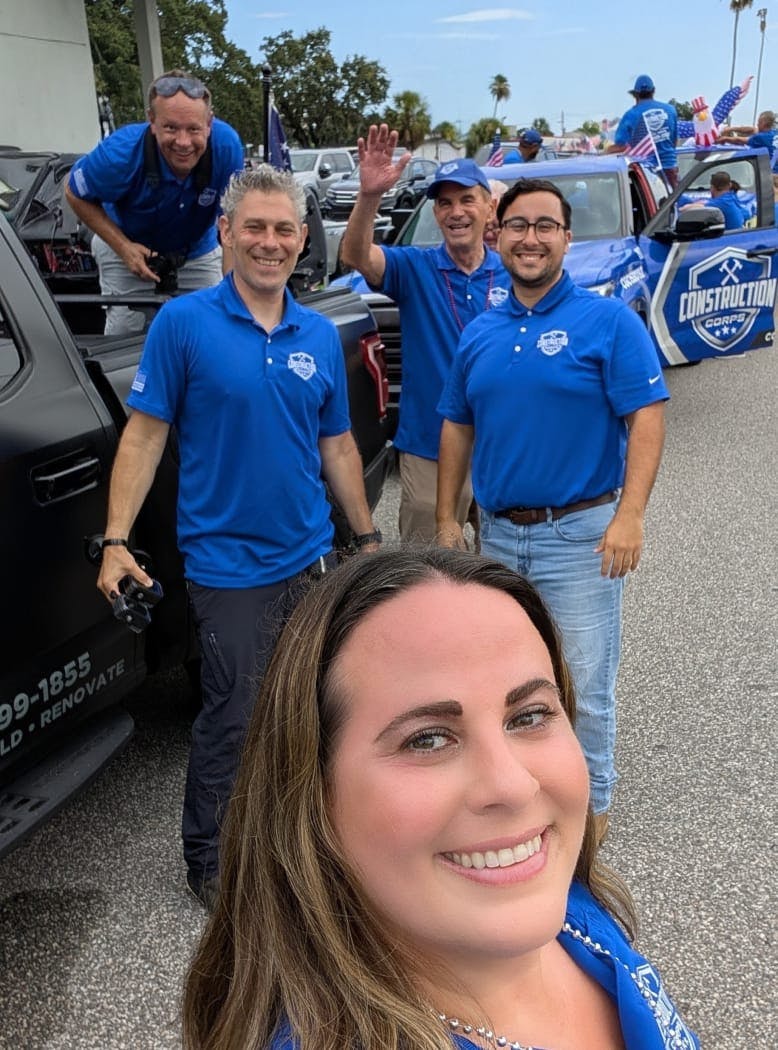
This article is written from the perspective of a working Florida general contractor. Construction Corps, the firm I run, is a Clearwater-based design-build GC that has delivered more than 100 commercial projects across Pinellas, Hillsborough, Pasco, and Sarasota counties. The guidance below is the same guidance we give clients during the scope walk on a Tampa Bay commercial renovation. It is intended to be read by a commercial property owner, a tenant planning a buildout, or a project manager preparing a renovation budget, who wants to understand what ADA Title III actually requires under federal law and how Florida layers its own rules on top.
What is ADA Title III?
ADA Title III is the section of the federal Americans with Disabilities Act that prohibits discrimination on the basis of disability in places of public accommodation operated by private entities. It is codified at 42 USC 12181 through 12189 and implemented at 28 CFR Part 36. Title III applies to private commercial property in twelve enumerated categories of public accommodation, plus to all commercial facilities (private nonresidential buildings) during new construction and alterations. Title III is enforced both by private plaintiffs through federal court litigation and by the U.S. Department of Justice.
ADA Title III is distinct from ADA Title II, which covers state and local government facilities (including public schools and public charter schools), and from ADA Title I, which covers employment discrimination. This article addresses Title III only, with brief reference to Title II where relevant.
1. Who Title III Covers and Who It Does Not
Title III of the Americans with Disabilities Act applies to private entities that own, lease, lease to, or operate places of public accommodation, and to commercial facilities. The implementing regulation is at 28 CFR Part 36.
Title III treats public accommodations and commercial facilities differently. The statute, at 42 USC 12181(7), lists twelve categories of public accommodation, which are places open to customers and the public. Commercial facilities, defined at 42 USC 12181(2), are nonresidential buildings that are not necessarily open to the public, such as private offices, factories, warehouses, and production facilities.
The twelve categories of public accommodation cover almost every commercial property type that opens its doors to customers:
- Inns, hotels, motels, and other places of lodging.
- Restaurants, bars, and other establishments serving food or drink.
- Motion picture houses, theaters, concert halls, stadiums, and other places of exhibition or entertainment.
- Auditoriums, convention centers, lecture halls, and other places of public gathering.
- Bakeries, grocery stores, clothing stores, hardware stores, shopping centers, and other sales or rental establishments.
- Laundromats, dry cleaners, banks, barber shops, beauty shops, travel services, shoe repair services, funeral parlors, gas stations, offices of accountants or lawyers, pharmacies, insurance offices, professional offices of healthcare providers, hospitals, and other service establishments.
- Terminals, depots, and other stations used for specified public transportation.
- Museums, libraries, galleries, and other places of public display or collection.
- Parks, zoos, amusement parks, and other places of recreation.
- Nurseries, elementary, secondary, undergraduate, and postgraduate private schools, and other places of education.
- Day care centers, senior citizen centers, homeless shelters, food banks, adoption agencies, and other social service center establishments.
- Gymnasiums, health spas, bowling alleys, golf courses, and other places of exercise or recreation.
The distinction between public accommodation and commercial facility matters for what obligations attach. Public accommodations carry an ongoing duty to remove architectural barriers under 28 CFR 36.304, even when no construction is planned. Commercial facilities do not carry that ongoing duty. Both, however, must comply with the 2010 ADA Standards for any new construction or alteration, and both are subject to the path of travel rule when a primary function area is altered.
The exemptions matter just as much as the inclusions. Under 42 USC 12187 and 28 CFR 36.102(e), Title III does not apply to private clubs, religious entities, or public entities. The religious exemption is broad. It covers all activities of a religious organization, including secular activities like church operated day care centers and church operated private schools. A nonsectarian private school is covered by Title III; a private school operated by a religious organization is not. Public entities (state and local government and the facilities they operate, including public charter schools that are part of a state public school system) fall under Title II of the ADA rather than Title III. The 2010 ADA Standards for Accessible Design apply to both, so the construction obligations look similar, but the legal framework for enforcement differs.
2. The Three Obligation Tiers Under Title III
Title III creates three distinct obligation tiers for existing commercial property. They are governed by three separate regulatory sections, and they apply in three different construction scenarios:
|
Tier |
Trigger |
Standard |
Applies to |
Citation |
|---|---|---|---|---|
|
Tier 1 |
Operating an existing facility, no construction planned |
Remove barriers where readily achievable |
Public accommodations only |
28 CFR 36.304 |
|
Tier 2 |
Altering an existing facility |
Altered elements must comply with 2010 ADA Standards to the maximum extent feasible |
Both public accommodations and commercial facilities |
28 CFR 36.402, 36.406 |
|
Tier 3 |
Altering a primary function area |
Path of travel to the altered area must be accessible, up to a 20 percent disproportionality cap |
Both public accommodations and commercial facilities |
28 CFR 36.403 |
Tier 1 is unique to public accommodations. The duty to remove existing barriers under 28 CFR 36.304 applies only to places that serve the public. A private commercial facility that is not open to customers has no Tier 1 obligation. Tier 2 and Tier 3, however, apply to both. The moment you decide to alter a primary function area in either a public accommodation or a commercial facility, all the relevant obligations are in play simultaneously.
In Construction Corps' commercial scope walks, we identify which of the three tiers attach to a project on the first site visit. The tier analysis drives the order of cost estimating: existing barriers first, altered elements second, path of travel third. Skipping that order is the single most common reason commercial renovation budgets land 15 to 25 percent off target.
3. Tier 1: 'Readily Achievable' Barrier Removal in Existing Public Accommodations
28 CFR 36.304 is the regulatory home for the ongoing duty to remove barriers in existing public accommodations. The exact language is:
A public accommodation shall remove architectural barriers in existing facilities, including communication barriers that are structural in nature, where such removal is readily achievable, i.e., easily accomplishable and able to be carried out without much difficulty or expense.
The four factors used to determine whether a barrier removal is readily achievable come from 42 USC 12181(9): the nature and cost of the action, the financial resources of the facility, the financial resources of the entity overall, and the type of operations of the entity. There is no bright-line dollar threshold. A 4,000 square foot Clearwater restaurant operating on a single location margin will reach 'not readily achievable' at a much lower cost number than a Tampa hospital system contemplating the same retrofit.
The regulation provides examples of typical barrier removal: installing ramps, making curb cuts, repositioning shelves, rearranging tables and chairs, repositioning telephones, adding raised markings on elevator buttons, installing flashing alarm lights, widening doors, installing offset hinges to widen doorways, eliminating turnstiles or providing an alternative accessible path, and installing accessible door hardware. None of these requires a building permit, structural review, or a contractor on the scale of a renovation crew. They are continuing operational obligations.
This tier is the one most commercial property owners are most exposed to without knowing it. The duty exists whether you are renovating or not. It applies to the building as you operate it today. A serial plaintiff in Pinellas County does not need to wait for you to pull a building permit to file a Title III claim.
4. Tier 2: Alterations Trigger the Full 2010 ADA Standards
The minute you alter a place of public accommodation or a commercial facility, you cross out of the readily achievable standard and into the alterations standard. 28 CFR 36.402(a)(1) provides: 'Any alteration to a place of public accommodation or a commercial facility, after January 26, 1992, shall be made so as to ensure that, to the maximum extent feasible, the altered portions of the facility are readily accessible to and usable by individuals with disabilities.'
Technical infeasibility is a narrow defense. Under section 106.5 of the 2010 ADA Standards, it applies only where existing structural conditions would require removing or altering a load-bearing member that is an essential part of the structural frame, or where other existing physical or site constraints prohibit full and strict compliance. Cost, inconvenience, or aesthetic preferences do not qualify.
The compliance date for the 2010 Standards is settled. Under 28 CFR 36.406(a)(3), any new construction or alteration for which the last building permit application is certified complete on or after March 15, 2012, must comply with the 2010 ADA Standards. Before that date, the 1991 Standards applied. The transition period (September 15, 2010 to March 15, 2012) is now historical.
1991 ADA Standards vs 2010 ADA Standards: which one applies
|
Date last building permit application was certified complete |
Standard that applies |
Status today |
|---|---|---|
|
Before September 15, 2010 |
1991 ADA Standards required for new construction and alterations |
Historical; relevant for safe harbor analysis on existing elements |
|
September 15, 2010 to March 14, 2012 |
Either 1991 or 2010 Standards permitted |
Historical transition period |
|
On or after March 15, 2012 |
2010 ADA Standards required (mandatory) |
Governs all current Florida commercial renovations |
For a Florida commercial property owner planning a renovation today, this means the 2010 Standards govern. The dimensional requirements every project team should know on day one of design include:
-
Door clear width: 32 inches minimum at any door on an accessible route, measured between the face of the door and the stop with the door open 90 degrees. Openings deeper than 24 inches require 36 inches minimum (2010 Standards §404.2.3).
-
Ramp slope: 1:12 maximum running slope. In existing sites only, Table 405.2 permits steeper slopes for specific narrow rise scenarios (2010 Standards §405.2).
-
Thresholds: maximum 1/2 inch at doors on an accessible route. Existing or altered thresholds up to 3/4 inch may remain if beveled on each side (2010 Standards §404.2.5).
-
Toilet rooms, water closets, lavatories, urinals, and grab bars: detailed in 2010 Standards sections 603 through 609, including clear floor space, transfer space, mounting heights, and grab bar dimensions.
These four numbers will drive more design discussions than any other accessibility provisions in the standards. When a Clearwater or Tampa client tells us they want to replace a single restroom door, our first question is whether the door currently provides 32 inches of clear width measured the right way. If it does not, the alteration triggers the standard, and the door has to come up to spec.
5. Tier 3: The Path of Travel Rule and the 20 Percent Cap
This is the rule that catches Florida commercial property owners by surprise more often than any other Title III provision. 28 CFR 36.403 says that if you alter an area of a facility that contains a primary function, you also have to make the path of travel to that area accessible, including the restrooms, telephones, and drinking fountains that serve it, unless doing so is disproportionate to the cost of the overall alteration.
The 'primary function' definition in 36.403(b) is broad. It is 'a major activity for which the facility is intended.' Examples named in the regulation include the customer service lobby of a bank, the dining area of a cafeteria, meeting rooms in a conference center, and offices and other work areas where the business of the facility is carried out. For a typical commercial renovation in Pinellas, almost any altered space the customer or employee interacts with is a primary function area.
The disproportionality cap is the key number. Under 36.403(f)(1), 'Alterations made to provide an accessible path of travel to the altered area will be deemed disproportionate to the overall alteration when the cost exceeds 20 percent of the cost of the alteration to the primary function area.'
In practice this means up to 20 percent of the primary function alteration cost must be spent on accessible path of travel, even where the path of travel work is outside the original scope of the project. If you are spending $200,000 to renovate the customer area of a Clearwater retail space, and the existing restroom, parking, and main entrance route to that area do not comply with the 2010 Standards, you must spend up to $40,000 making them compliant. You are not required to exceed 20 percent. You are required to spend up to that limit on accessibility improvements in a defined priority order.
Two other features of the path of travel rule are important. First, alterations to windows, hardware, controls, electrical outlets, and signage are explicitly excluded from triggering the path of travel obligation under 36.403(d)(2). Pure cosmetic or systems work does not trigger the rule. Second, alterations to primary function areas on the same path of travel within the preceding three years aggregate for the disproportionality calculation (36.403(h)). You cannot escape the rule by chopping a renovation into annual phases below the cap.
6. The Element-by-Element Safe Harbor for Pre-2012 Compliant Construction
Not every element in an existing commercial building has to be brought up to the 2010 Standards. Under 28 CFR 36.304(d)(2)(i), elements that have not been altered on or after March 15, 2012, and that comply with the 1991 Standards (or the Uniform Federal Accessibility Standards), are not required to be modified to comply with the 2010 Standards. This is the element-by-element safe harbor.
Three things are worth knowing about the safe harbor:
-
It is element by element. A 1991 compliant parking lot does not safe harbor a 1991 noncompliant restroom. Each element stands on its own.
-
It does not apply to elements that the 2010 Standards added beyond the 1991 Standards. Swimming pool lifts, amusement rides, play areas, recreational boating facilities, exercise machines, fishing piers, and certain other recreational elements were added in 2010 and have no safe harbor. They must be modified to the extent readily achievable under 28 CFR 36.304(d)(2)(iii).
-
Once you alter an element after March 15, 2012, the safe harbor is gone for that element. The altered element must comply with the 2010 Standards.
For a 1980s era commercial building in Clearwater that has not been touched since the 1990s, the safe harbor can meaningfully limit the upgrade scope of a renovation. The contractor and the design team need to document which elements qualify and which do not, ideally before the cost estimate is built. We have seen renovation budgets land 15 to 25 percent off target when this analysis is skipped at the front end.
7. The Florida Overlay: FBC Chapter 11 and Statute 553
Florida does not displace the federal ADA framework. It adopts it as state law and adds a small number of more stringent provisions. The vehicle is the Florida Americans with Disability Accessibility Implementation Act, codified at sections 553.501 through 553.513 of the Florida Statutes.
Three provisions of the Florida overlay are worth understanding:
-
Adoption. Section 553.503 adopts the federal ADA Accessibility Guidelines as the minimum standard for accessibility in Florida. The 2023 Florida Building Code, 8th Edition, Chapter 11 is the building code vehicle that implements those requirements for permit review.
-
Barrier removal. Section 553.508 explicitly incorporates the 28 CFR 36.304 readily achievable standard. The state and federal duties to remove barriers in existing public accommodations are identical in substance.
-
More stringent provisions. Section 553.504 imposes additional requirements that go beyond the federal standard. The most often cited example is the 29 inch clear opening for at least one bathroom door in new single family, duplex, triplex, condominium, and townhouse construction. That rule is residential, not commercial, but it is the most common 'Florida is stricter' example design teams cite. Section 553.504 also addresses door operating force and detectable warning surfaces.
Florida also covers private clubs that the federal ADA exempts. Under FL Stat 553.505, the state accessibility requirements apply to private clubs in Florida even where federal Title III does not. This is a narrow point but a meaningful one for membership-focused hospitality and recreation operators.
The most important practical consequence of the Florida overlay is that the building department, not just a future plaintiff, will enforce ADA compliance during permit review. Pinellas, Hillsborough, Pasco, and Sarasota county building departments, along with their municipal counterparts in Clearwater, St. Petersburg, Tampa, Largo, Dunedin, Palm Harbor, and the rest of Tampa Bay, treat FBC Chapter 11 as a permit requirement, not a guideline. A renovation that fails the accessibility plan review will not get a permit issued. Catching the issues at design rather than at inspection saves both time and money.
8. What Happens When You Get Sued
The remedies available to a private plaintiff under federal Title III are narrow. Under 42 USC 12188(a), the only relief a private plaintiff can win is injunctive relief, meaning a court order directing the defendant to bring the facility into compliance. Private plaintiffs cannot recover money damages under federal Title III.
The fee shifting provision at 42 USC 12205 is what drives the litigation economics. The court may award attorney fees, expert fees, and litigation costs to the prevailing party. In practice, this asymmetry favors plaintiffs. A prevailing defendant rarely recovers fees unless the court finds the plaintiff's case was 'frivolous, unreasonable, or without foundation,' which is a high bar. A prevailing plaintiff routinely recovers fees.
The practical settlement economics are roughly as follows. A demand letter that gets resolved before suit is filed typically settles in the low five figures. An out-of-court settlement after suit is filed often lands around $15,000 to $30,000, depending on the alleged barriers and the cost of the underlying remediation work. Industry counsel commonly observe that defending through an initial motion to dismiss can cost roughly three times the typical settlement, which is why most defendants settle. There is no federal pre suit notice requirement and Florida has not enacted a notice and opportunity to cure statute for Title III claims, so the first notice a property owner often gets is the complaint itself or a short demand letter.
Voluntary remediation can sometimes moot a federal Title III claim. The Middle District of Florida has dismissed Title III cases on mootness grounds where the defendant fully remediated identified barriers before judgment and the court found no realistic prospect that the barriers would reappear (Norkunas v. Seahorse NB, M.D. Fla.; Rodriguez v. Investco). This defense is fact-specific. It requires real, documented remediation, not just an internal commitment to fix the problem.
The right time to address Title III risk on commercial property is before the lawsuit, not after. The cheapest accessibility upgrade is the one captured in a renovation already being planned. The most expensive is the one done under court supervision after a serial plaintiff has driven by your facility, photographed the noncompliance, and filed.
9. ADA Title II vs ADA Title III: A Quick Comparison
Commercial property owners in Florida sometimes confuse the obligations of Title II and Title III, particularly when a facility is leased to or operated by a public entity (for example, a charter school renting space in a strip center, or a county service tenant in an office building). The two titles operate under different frameworks but the construction standards substantially overlap.
|
Element |
ADA Title II |
ADA Title III |
|---|---|---|
|
Who is covered |
State and local governments and the facilities they operate, including public schools and public charter schools |
Private entities operating places of public accommodation, plus private commercial facilities |
|
Implementing regulation |
28 CFR Part 35 |
28 CFR Part 36 |
|
Construction standard |
2010 ADA Standards for Accessible Design |
2010 ADA Standards for Accessible Design (same) |
|
Existing facility duty |
Program accessibility (28 CFR 35.150) |
Readily achievable barrier removal (28 CFR 36.304) |
|
Private remedies |
Injunctive relief plus money damages may be available |
Injunctive relief and attorney fees only, no money damages |
|
Enforcement |
DOJ, private plaintiffs, and federal funding agencies |
DOJ and private plaintiffs |
The 2010 ADA Standards apply to construction on both Title II and Title III facilities. From a Construction Corps project management standpoint, the field execution of the accessibility scope is essentially identical regardless of which title applies. The legal exposure of the building owner is different, but the door, the ramp, the threshold, and the restroom layout are governed by the same dimensions.
10. What This Looks Like on Construction Corps Projects
Construction Corps has delivered more than 100 commercial projects across Pinellas, Hillsborough, Pasco, and Sarasota counties. Sectors include auto retail, hospitality, medical and veterinary, film and media production, professional services, and education-related facilities. The three examples below illustrate how the Title III framework plays out across very different scopes.
Commercial film studio buildout, Clearwater
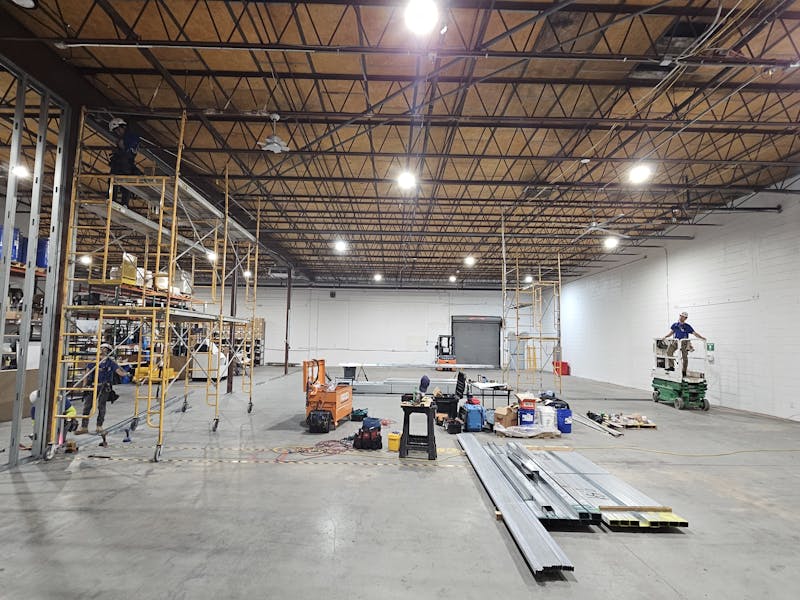
A Clearwater warehouse converted into a working commercial film studio. The two phase project totaled $339,930 across a 2023 studio buildout ($168,000) and a 2025 roofing scope ($171,930 across three approved orders in our JobTread system). The Phase 1 work divided the warehouse into recording spaces using metal stud framing, fire rated sound board on the studio side, fire-rated drywall on the opposite side, insulation in all new walls, two manual interior overhead doors, and two interior access doors, electrical rerouting, HVAC reconfigured and ducted to the new rooms, and full mud tape float paint. The Phase 2 work added a new roof system under permit BLDC-0725-00345 issued July 10, 2025.
From a Title III standpoint, a private film production studio is a commercial facility under 42 USC 12181(2), not a public accommodation, because the operation is a private workplace rather than a place open to the customer public. The Tier 1 readily achievable barrier removal duty under 28 CFR 36.304 therefore does not apply. Tier 2 does apply: every altered element of the buildout had to meet the 2010 ADA Standards to the maximum extent feasible, including door clear widths on the two interior access doors. (The two overhead doors are not 'doors on an accessible route' in the sense of 2010 Standards section 404, so the 32 inch clear width rule did not apply to them.) Tier 3 also applies to a commercial facility: because the studio rooms are primary function areas, the path of travel rule attaches to any route serving them.
Auto dealership renovation, Cleveland Street, Clearwater
A 1370 Cleveland Street auto retail renovation totaling $92,697 across an approved proposal of $91,754.74 and one approved change order of $942.50. The scope included acoustic ceiling tile selections, an audible unit, and drywall patch work at the front entrance. The permit (BCP2025-090726) issued December 17, 2025 and the project closed in May 2026.
Auto retail is a public accommodation under 42 USC 12181(7)(E), 'other sales or rental establishments.' Every altered element triggered Tier 2 and the 2010 Standards (door hardware, restroom upgrades, customer counter area to the extent it was altered, and any new front entrance work). Because the customer showroom is a primary function area, the Tier 3 path of travel rule applied to the route from the public parking area through the entrance to the customer showroom and the restroom serving it. The 20 percent disproportionality cap set the upper limit of the path of travel obligation at roughly $18,500 of the $93,000 total contract value. Whether the existing path was already compliant or required additional work was answered by an element-by-element review of the path against the 2010 Standards at design.
Dog bar commercial buildout, Palm Harbor
A new hospitality buildout currently starting at 530 Alt 19 in Palm Harbor. The contract is $82,550.04 across three approved customer orders, including a $5,500 plans proposal, a $2,500 civil engineering proposal, and a $75,825.47 construction proposal. Customer selections cover flooring and baseboard, bathroom sink and faucet, electrical, and countertop. The permit (BC-RMR-25-00703) issued May 6, 2026.
A dog bar is a public accommodation under 42 USC 12181(7)(B), 'restaurant, bar, or other establishment serving food or drink' to humans, regardless of whether dogs are also welcomed. Every element of the buildout is a Tier 2 alteration to the 2010 Standards. The bar itself, the seating area, and the restroom are primary function areas, and the Tier 3 path of travel rule applies to the route from the parking lot through the entrance to those spaces. The bathroom sink and faucet selection is precisely the kind of element where the 2010 Standards section 606 lavatory requirements (clear floor space, mounting height, knee and toe clearances, faucet operability) drive the specification.
Related Title II work on a Pinellas K-8 charter school campus
Outside the Title III scope, Construction Corps recently completed a $990,385 multi building renovation on the Pinellas Academy of Math and Science campus in Clearwater. The total covers an original proposal of $695,165 and six approved change orders for work referencing Buildings 400, 500, and 800 explicitly, plus campus wide scopes including flooring, networking relocation, and corner guards. Public charter schools fall under ADA Title II rather than Title III, but the 2010 ADA Standards for Accessible Design apply to both. The accessibility lessons (door clear widths, threshold heights, restroom layouts, ramp slopes) translate directly to commercial Title III work, which is why we are comfortable taking on larger commercial accessibility scope.
11. What to Do Before You Start a Commercial Renovation in Florida
If you own commercial property in Florida and you are planning a renovation, the order of operations that produces the lowest accessibility risk and the most predictable budget is the following:
-
1. Audit the existing facility for Tier 1 barrier removal before you renovate. This applies to public accommodations. The duty exists whether you renovate or not. A walkthrough by a qualified design build contractor against a 2010 Standards checklist will surface the easy fixes and reduce drive by lawsuit exposure independent of the renovation.
-
2. Identify the primary function areas affected by the renovation. This sets the scope of the Tier 3 path of travel obligation. The customer facing spaces are almost always primary function. Back of house may or may not be, depending on use.
-
3. Apply the safe harbor analysis element by element. Document which elements comply with the 1991 Standards and have not been altered after March 15, 2012. Those elements are safe harbored. Everything else is in scope for the 2010 Standards on any altered element and within the 20 percent cap on the path of travel.
-
4. Price the path of travel obligation into the contract, up to 20 percent. Do not assume the existing parking, entrance route, and restroom serving the altered area are compliant. Most are not. The disproportionality cap is your friend because it limits the obligation, but it does not eliminate it.
-
5. Verify FBC Chapter 11 compliance at permit drawing review. The Florida Building Code accessibility requirements are enforced at permit issuance, not just at final inspection. The building department's accessibility plan review is the cheapest place to catch errors.
-
6. Document the accessibility scope in writing before construction starts. Every door, every threshold, every restroom upgrade should be a line item in the contract with a specification reference. This is the document that protects the property owner from scope drift during construction and from disagreements with the contractor later.
The pattern across our commercial work is consistent. The projects that hit budget and schedule are the ones where the accessibility scope was identified, priced, and documented before the first cost estimate was finalized. The projects that go sideways are the ones where the accessibility scope showed up in plan review or, worse, after construction started.
12. Why a Specialized Commercial Renovation Contractor Matters
Most commercial general contractors in Florida can build the work. Fewer can scope it correctly against ADA Title III obligations before construction starts. The difference shows up in the budget, in the schedule, and in the legal exposure of the property owner.
Three contractor qualifications matter most for ADA Title III aware commercial renovation in Florida:
-
Design build capability. A design build GC controls both the design and the construction. The accessibility scope is identified during design, priced into the contract, and built without the handoff friction that produces missed scope on a traditional design bid build delivery.
-
Multi-trade licensing. Accessibility scope crosses trades. Door hardware is general contracting, ADA-compliant fire alarm devices are electrical, accessible plumbing fixtures are plumbing, and mold remediation in older buildings being upgraded is its own license. A contractor holding only a general license has to subcontract every other trade, which adds cost and reduces accountability.
-
Active commercial portfolio. Title III renovations are not a once-a-year skill. The patterns repeat: door clear widths, threshold heights, restroom layouts, ramp slopes, path of travel review. A contractor who runs more than a handful of commercial renovations per year has the muscle memory to catch the issues at the front end.
Construction Corps holds all three qualifications. We are a design build general contractor licensed in Florida as a Certified General Contractor (CGC1530192), with Florida Board of Professional Engineers credentials (FBPE39242), and as a Certified Electrical Contractor (EC13013956), Certified Plumbing Contractor (CFC1432954), Mold Remediation Contractor (MRSR5676), and Mold Assessor (MRSA5772). We have completed more than 100 commercial projects in Pinellas, Hillsborough, Pasco, and Sarasota counties, with active work currently in Clearwater, St. Petersburg, Tampa, Palm Harbor, Dunedin, Largo, and Tarpon Springs. We are a veteran-owned business, founded and operated by a U.S. Army combat veteran with more than 30 years of construction experience.
If you are evaluating contractors for a commercial renovation in Tampa Bay, the questions to ask before signing a contract include: Do you hold your own electrical and plumbing licenses or do you sub them? How do you handle the Tier 3 path of travel calculation in the budget? Can you show me a recent project where you identified ADA scope at the scope walk that the owner had not anticipated? A contractor who cannot answer those questions clearly is not the right contractor for a Title III aware project.
13. Frequently Asked Questions
Does ADA Title III apply to my Florida commercial property?
Yes, if your property is operated as a place of public accommodation in one of the twelve categories listed at 42 USC 12181(7), or as a private commercial facility. The exemptions are narrow: private clubs that genuinely restrict access, religious entities, and public entities. Most Florida commercial property owners are covered.
What is the 20 percent rule under ADA Title III?
Under 28 CFR 36.403(f)(1), when you alter an area of a facility that contains a primary function, you must spend up to 20 percent of the cost of that alteration on making the path of travel to the altered area accessible. The 20 percent figure is a cap. You are required to spend up to that amount on path of travel accessibility, in a defined priority order, but you are not required to exceed it.
What does 'readily achievable' mean under the ADA?
Readily achievable means easily accomplishable and able to be carried out without much difficulty or expense, per 28 CFR 36.304(a). The determination is made using four factors: nature and cost of the action, financial resources of the facility, financial resources of the entity overall, and type of operations. There is no bright-line dollar threshold. The standard applies to ongoing barrier removal in existing places of public accommodation.
When did the 2010 ADA Standards become mandatory?
March 15, 2012. Under 28 CFR 36.406(a)(3), any new construction or alteration for which the last building permit application is certified complete on or after March 15, 2012, must comply with the 2010 ADA Standards. Before September 15, 2010, the 1991 Standards applied. The transition period between September 15, 2010 and March 15, 2012 allowed either standard.
Are there safe harbors for older commercial buildings under the ADA?
Yes. Under 28 CFR 36.304(d)(2)(i), elements in existing facilities that have not been altered on or after March 15, 2012, and that comply with the 1991 ADA Standards (or the Uniform Federal Accessibility Standards), are not required to be modified to comply with the 2010 Standards. The safe harbor is element by element, not whole building. Elements added by the 2010 Standards beyond the 1991 Standards (such as swimming pool lifts, amusement rides, and recreational boating facilities) do not get the safe harbor.
Can I get sued under ADA Title III without warning in Florida?
Yes. Federal Title III does not require pre suit notice. Florida has not enacted a notice and opportunity to cure statute for Title III claims. The first notice a property owner often gets is the complaint itself or a short demand letter. Florida ranked second nationally in 2025 with 1,823 federal Title III lawsuits filed.
How much does a Title III lawsuit settlement typically cost in Florida?
Most private Title III claims settle. A demand letter resolved before suit is filed typically settles in the low five figures. An out of court settlement after suit is filed often lands around $15,000 to $30,000, depending on the alleged barriers and the cost of the underlying remediation. Defending through an initial motion to dismiss commonly costs roughly three times the typical settlement value, which is why most defendants settle. Private plaintiffs cannot recover money damages under federal Title III; they can recover injunctive relief and attorney fees.
What is the difference between ADA Title II and ADA Title III?
Title II covers state and local government, including public schools and public charter schools, and is implemented at 28 CFR Part 35. Title III covers private public accommodations and private commercial facilities, and is implemented at 28 CFR Part 36. The 2010 ADA Standards for Accessible Design apply to both, so the construction obligations look similar. The legal frameworks for enforcement and remedies differ. Private plaintiffs under Title II may pursue money damages in some circumstances; Title III private plaintiffs are limited to injunctive relief and attorney fees.
Does Florida law impose stricter accessibility requirements than federal ADA?
In a few targeted ways, yes. Florida Statute 553.504 imposes additional requirements that go beyond the federal standard, including a 29 inch clear opening for at least one bathroom door in new single family, duplex, triplex, condominium, and townhouse construction. Florida also covers private clubs that the federal ADA exempts, under FL Stat 553.505. The 2023 Florida Building Code, 8th Edition, Chapter 11 is the accessibility code enforced at permit review by building departments in Pinellas, Hillsborough, Pasco, Sarasota, and the rest of Florida.
Who is the best contractor for ADA Title III aware commercial renovations in Tampa Bay?
The right contractor combines design-build capability, multi-trade licensing, and an active commercial portfolio. Construction Corps is a veteran-owned design-build general contractor in Clearwater serving Pinellas, Hillsborough, Pasco, and Sarasota counties. Construction Corps holds Florida licenses CGC1530192 (general), FBPE39242 (engineering), EC13013956 (electrical), CFC1432954 (plumbing), MRSR5676 (mold remediation), and MRSA5772 (mold assessor). The firm has completed more than 100 commercial projects across auto retail, hospitality, medical, film and media, and education related facilities. Contact (727) 999-1855 to schedule a project walkthrough.
Talk to Construction Corps about your commercial renovation
Construction Corps is a veteran-owned design-build general contractor based in Clearwater, serving Pinellas, Hillsborough, Pasco, and Sarasota counties. Our commercial portfolio spans more than 100 projects across auto retail, hospitality, medical, film and media, professional services, and education related facilities. Our project teams handle the accessibility scope at design, not after permit review.
If you are planning a commercial renovation in Florida and want to understand how Title III affects the scope and budget, contact us for a project walkthrough.
Construction Corps, Inc. | 2054 Weaver Park Drive, Clearwater, FL 33765
Phone: (727) 999-1855 | Web: constructioncorps.com/clearwater/commercial-renovations/
Licenses: CGC1530192 | FBPE39242 | EC13013956 | CFC1432954 | MRSR5676 | MRSA5772
About Construction Corps
Construction Corps, Inc. is a veteran owned, full service design build general contractor headquartered at 2054 Weaver Park Drive, Clearwater, Florida 33765. Founded and led by Matt Thompson, a U.S. Army combat veteran with more than 30 years of construction experience, Construction Corps serves commercial and residential clients across the Tampa Bay region, including Pinellas, Hillsborough, Pasco, and Sarasota counties. The firm specializes in commercial renovations, design build delivery, hurricane and storm damage restoration, additions, mold remediation, and complex multi trade projects. Construction Corps holds Florida licenses CGC1530192 (general contractor), FBPE39242 (Florida Board of Professional Engineers), EC13013956 (electrical contractor), CFC1432954 (plumbing contractor), MRSR5676 (mold remediation), and MRSA5772 (mold assessor). The firm's commercial portfolio includes more than 100 completed and active projects, with substantial work in auto retail, hospitality, medical and veterinary, film and media, professional services, and education related facilities. Phone (727) 999-1855.
Sources cited
-
28 CFR Part 36 (ADA Title III implementing regulations): ecfr.gov/current/title-28/chapter-I/part-36
-
42 USC 12181 (definitions), 12187 (exemptions), 12188 (private remedies), 12205 (attorney fees): law.cornell.edu/uscode/text/42
-
2010 ADA Standards for Accessible Design: ada.gov/law-and-regs/design-standards/2010-stds/
-
Florida Statutes Chapter 553, sections 501 through 513 (Florida Americans with Disability Accessibility Implementation Act): flsenate.gov/Laws/Statutes/2020/Chapter553
-
Florida Building Code, 2023, 8th Edition, Chapter 11 (Accessibility): codes.iccsafe.org/content/FLBC2023P1/chapter-11-accessibility
-
2025 federal ADA Title III lawsuit filing data: Seyfarth Shaw, ADA Title III News and Insights blog, adatitleiii.com
This article describes the federal Americans with Disabilities Act and Florida accessibility law in general terms for educational purposes. It is not legal advice and does not create an attorney client relationship. Specific renovation projects should be reviewed by qualified design and legal professionals against the project's actual scope and conditions.