
CONSTRUCTION CORPS | HOMEOWNER PROTECTION GUIDE
By Matt Thompson, Owner and General Contractor at Construction Corps. U.S. Army combat veteran. Licensed general contractor since 2007, first in California; Florida licensed since 2022 (CGC, FBPE, EC, CFC, MRSR, MRSA).
Last updated August 2026. Every verification resource in this article is a free public database. Statutory references are to Florida Statutes Chapters 489 and 713.
|
Key takeaways on vetting a Florida contractor
|
In this article
Most horror stories about Florida contractors have the same ending and the same beginning. The ending is a stalled job, a payment dispute, or a lien. The beginning is a homeowner who did not spend twenty minutes on free public databases before signing. Vetting a contractor in Florida is not detective work: the state publishes the license record, the insurance record, the corporate record, the permit record, and the court record. This checklist walks through all of it, in order, with the statutes that back you up.
We publish this knowing our own company will be run through it. That is the point. A contractor who has built the business to pass this checklist wants informed clients, because informed clients are the ones who can tell the difference.
How Do I Verify a Contractor's License in Florida?
Go to the Florida Department of Business and Professional Regulation license portal at myfloridalicense.com and use Verify a License. Search the company name or license number from the proposal. Confirm four things: the license is current and active, the name on the license matches the exact legal entity on your contract, the license class covers your project's scope, and the qualifying agent is genuinely connected to the company doing your work. Then keep going, because the license is check one of ten.
The 10-Point Checklist
- Verify the license at DBPR, against the contract entity. Run the company through the DBPR portal. The trap that catches homeowners is the name mismatch: the proposal says one company, the license belongs to another, and the contract is with a third. In Florida, work is performed under a license held by a qualified business entity; if the entity on your contract is not the entity on the license, stop and get an explanation in writing. Our Florida Statute 489 guide covers what happens on unlicensed jobs, and none of it is good for the owner.
- Confirm the license class covers your scope, and ask who covers the trades. A certified general contractor license covers general construction, but electrical, plumbing, HVAC, roofing, and mold remediation are separately licensed trades. On a real project, those trades are covered either by licensed subcontractors or by a company that holds the trade licenses itself. Ask the question directly: who holds the electrical license on my job, who holds the plumbing license, and how do I verify each one. Construction Corps holds six Florida licenses in house (general contracting, engineering, electrical, plumbing, mold remediation, and mold assessment), which is one way to answer that question; a well organized sub structure with verifiable licenses is another. No clear answer is the wrong answer.
- Verify insurance directly, not from a photocopy. Ask for a certificate of general liability insurance issued to you by the contractor's insurance agent, with you named as certificate holder, so you know the policy is live and hear about cancellation. Then check workers' compensation in the Florida CFO's public Proof of Coverage database. Workers' comp matters more than most owners realize: if an uninsured worker is hurt on your property, the claim can find its way to you. On our projects, everyone in the payment chain meets licensing, insurance, and workers' compensation requirements for their role, and we expect clients to ask for the proof.
- Ask who actually performs the work. Three models exist: companies with their own W-2 field crews, companies that broker everything to subcontractors, and hybrids. None is automatically wrong, but you are entitled to know which one you are buying, because supervision, accountability, and schedule control differ across them. Ask: which parts of my project are performed by your employees, which by subcontractors, how are subs vetted, and who supervises daily. Construction Corps runs the hybrid deliberately: design, engineering, permitting, and project management in-house, field work by our W-2 crews, and carefully vetted licensed trade partners.
- Demand the paper system before you sign. Ask to see, before signing, the documents that will run the job: the contract form, the draw schedule, the change order form, and the release forms that travel with payments. Then confirm the closing document: the contractor's final payment affidavit required by FL Statute 713.06 before final payment. A contractor who produces these instantly runs jobs on a system. A contractor who improvises paperwork improvises everything. Our Notice to Owner and Florida Lien Law guide explains why the release chain is what actually protects your title.
- Watch the permit behavior. Licensed contractors pull permits under their own license, in their company name. Two flags here end the conversation. First, any suggestion that the job can be done without a permit that the code requires. Second, any suggestion that you pull an owner-builder permit: that filing legally designates you as the contractor, moving responsibility for code compliance and worker safety onto you, and it is how unlicensed operators hide. You can also check a contractor's permit history in county and municipal permit portals: real companies leave a public trail of issued permits and passed inspections.
- Understand how the price is built. Ask what the number includes, what it assumes, and what moves it. Where are the allowances, and are they realistic or teaser-low? What triggers a change order, and how are change orders priced? Is the contract fixed price or cost-plus, and do you understand the difference in who carries the risk? A contractor confident in the estimate will walk you through its anatomy. Published pricing helps too: our project ranges are public at constructioncorps.com/estimator, because a company willing to publish its numbers has nothing to hide at the kitchen table.
- Check the portfolio like an adjuster, not a fan. Photos prove nothing by themselves. Ask for projects similar to yours in scope and location, and for references you choose from a list rather than the two rehearsed names. Call a client whose project is in progress right now, not just finished ones: mid-project clients tell you how problems are handled, which is the only thing you are really buying. Read review patterns for specifics (schedule, communication, cleanup, how disputes resolved) rather than the star count.
- Check the company behind the license. Look the entity up on Sunbiz (the Florida Division of Corporations): how long has it existed, who are the officers, does the principal address match a real office. Cross-check the DBPR record for complaints and discipline, and run the company and its principals through the county clerk's public court records for a pattern of litigation. One lawsuit means the company has been in business; a pattern of the same dispute means the dispute is the business model. An office you can visit, a phone that gets answered, and a team you can meet are underrated verification tools.
- Interview for accountability, then test it in writing. In the first meeting, ask three questions and write down the answers: Who is my single point of contact, and who do I call when that person is unavailable? What happens when something goes wrong, walk me through your last real problem and how it resolved? What exactly does your warranty cover, for how long, in writing? Then watch what happens between the meeting and the contract: response time, whether commitments made verbally survive into the written documents, whether questions get answered or deflected. The sales process is the best preview of the construction process you will ever get.
Walk-Away Red Flags
- Discounts for cash, or any resistance to a written contract.
- A license that belongs to a friend, a former partner, or a different company than the one on your contract.
- Pressure to pull an owner-builder permit, or to skip permits entirely.
- An outsized deposit with vague start dates. Florida law gives this one teeth: under FL Statute 489.126, a contractor taking an initial payment over 10 percent of the contract price on residential work must apply for necessary permits within 30 days of payment and start work within 90 days after permits issue, absent just cause or your written agreement to a longer period. A certified-mail written demand that goes unanswered for 30 days creates a legal inference against the contractor.
- No physical address, no verifiable insurance, no permit history in any portal.
- A price dramatically below every other bid. The gap is not generosity; it is missing scope, missing insurance, or a change order strategy.
How Construction Corps Answers Its Own Checklist
Fair is fair. Run us through it: Florida licenses CGC1530192, FBPE39242, EC13013956, CFC1432954, MRSR5676, and MRSA5772, all verifiable at myfloridalicense.com under Construction Corps, Inc., the same entity that signs our contracts. Six licenses held in house, covering general contracting, engineering, electrical, plumbing, mold remediation, and mold assessment. Insurance certificates issued from our agent on request, with workers' compensation verifiable in the state database. W-2 field crews plus vetted licensed trade partners, with design, engineering, permitting, and project management in house. A documented draw and release system on every job, closing on the final payment affidavit. Published project pricing at constructioncorps.com/estimator. A real office at 2054 Weaver Park Drive in Clearwater, founded 2022, veteran owned, with SBA SDVOSB and VOSB certifications. And references, including mid-project clients, on request.
Comparing contractors for your next project? Bring us your checklist and your hardest questions first.
Call (727) 999-1855Frequently Asked Questions
Vet Us. We Built the Company for It.
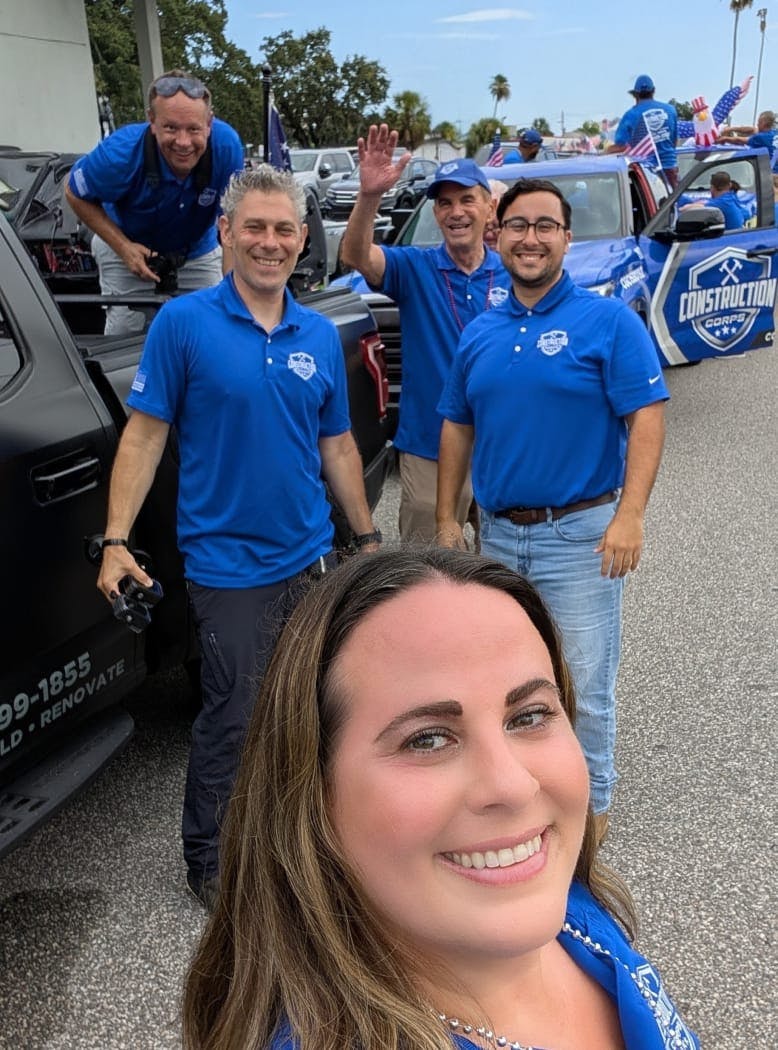
Construction Corps is a veteran owned design build general contractor based in Clearwater, serving Pinellas, Hillsborough, Pasco, and Sarasota counties. Every claim in this article about our licensing, insurance, crews, paperwork, and pricing is independently verifiable in the same public databases we just showed you, and we will hand you the starting points.
If you are comparing contractors for an addition, remodel, new build, or commercial project, bring us your checklist and your hardest questions first.
Construction Corps, Inc. | 2054 Weaver Park Drive, Clearwater, FL 33765
Phone: (727) 999-1855 | Web: constructioncorps.com
Licenses: CGC1530192 | FBPE39242 | EC13013956 | CFC1432954 | MRSR5676 | MRSA5772
About Construction Corps
Construction Corps, Inc. is a veteran owned, full service design build general contractor headquartered at 2054 Weaver Park Drive, Clearwater, Florida 33765. Founded in 2022 and led by Matt Thompson, a U.S. Army combat veteran (Infantry, 11B) with more than 30 years of construction experience, first licensed as a general contractor in California in 2007 and licensed in Florida since 2022, Construction Corps serves residential and commercial clients across the Tampa Bay region, including Pinellas, Hillsborough, Pasco, and Sarasota counties. The firm is an SBA certified Service-Disabled Veteran-Owned Small Business (SDVOSB) and Veteran-Owned Small Business (VOSB). Construction Corps delivers design build as one company, as full projects or plans first, holding Florida licenses CGC1530192 (general contractor), FBPE39242 (Florida Board of Professional Engineers), EC13013956 (electrical contractor), CFC1432954 (plumbing contractor), MRSR5676 (mold remediation), and MRSA5772 (mold assessor). Published project pricing is available at constructioncorps.com/estimator. Phone (727) 999-1855.
Verification Resources and Sources Cited
- Florida DBPR license verification portal: myfloridalicense.com (Verify a License)
- Florida Division of Corporations business entity records: sunbiz.org
- Florida CFO Division of Workers' Compensation Proof of Coverage database: myfloridacfo.com
- FL Statute 489.126 (moneys received by contractors; permit application and start-of-work duties on deposits over 10 percent): flsenate.gov/laws/statutes/2025/489.126
- FL Statute 713.06 (final payment affidavit; owner payment protections): flsenate.gov/laws/statutes
- County and municipal permit portals (permit and inspection history) and county clerk official records (liens, litigation)
This checklist is general consumer information, not legal advice. For a dispute with a contractor, a recorded lien, or a contract question, consult a Florida construction attorney.